When money flies without traveling—How Hawala really works
Hawala is an informal—and usually illegal—payment system, over 1,000 years old, in which money is transferred across borders without the involvement of banks or official financial service providers. In practice, you don’t spot Hawala by a sign on the door, but rather through word of mouth. That is precisely part of the system: it is meant to remain invisible.
It is a gray November evening, and Ahmed is standing in a small grocery store in Hamburg-Wilhelmsburg. Behind the counter sits a man everyone calls “Uncle Karim.” Ahmed places 1,200 euros on the counter.
“For my cousin Farid in Herat. He needs it for his mother’s surgery.”
Karim nods; he writes nothing in a ledger, but taps briefly on his mobile phone. Then he gives Ahmed a single word: *Samarqand*. “Tell him that. He can pick up the money in two hours.”
Ahmed leaves. No receipt. No bank transfer. No account. And yet, by the next morning, the money is sitting on a table in Afghanistan.
That is Hawala – A system older than any bank
In Arabic, *Hawala* translates roughly to “transfer” or “trust.” It originated over a thousand years ago along trade routes connecting the Middle East, South Asia, and North Africa. Merchants wanted to avoid the risks associated with gold caravans. So, they would hand the money to a trusted contact here—and another trusted contact would pay it out there.
It works exactly the same way today. The only difference is that the trusted contact is often found in a mobile phone shop, a snack bar, or a back room. He is known as a *Hawaladar*.
Ahmed’s transfer, step by step
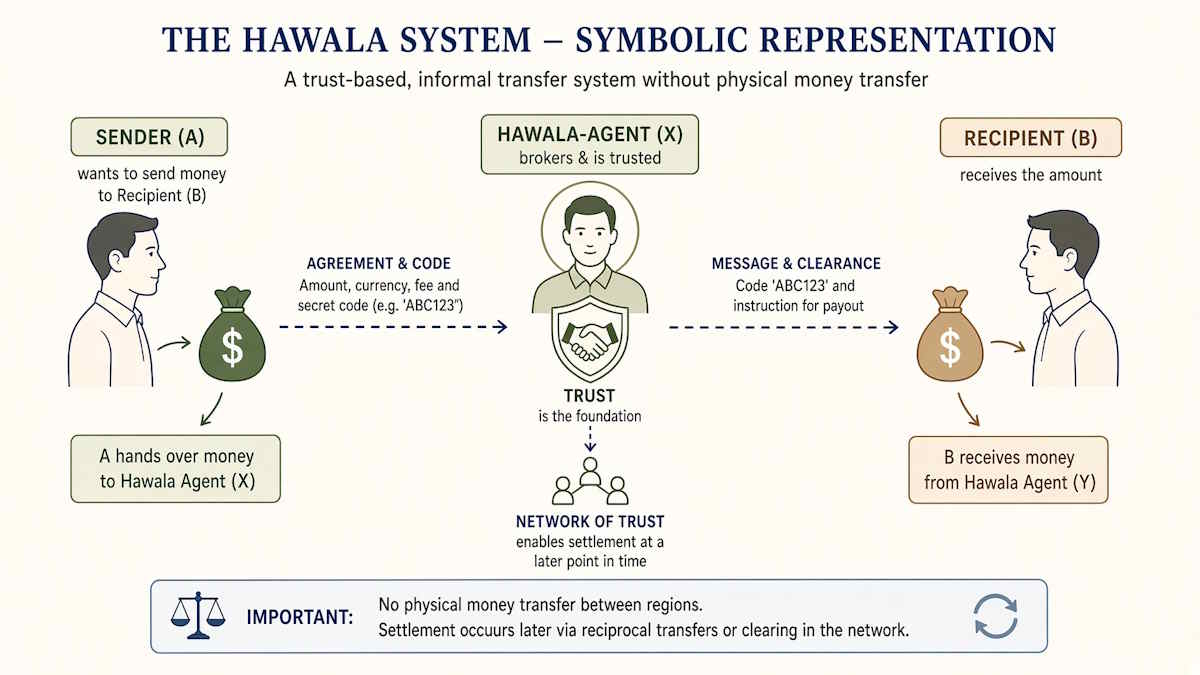
Ahmed hands cash to Karim in Hamburg. Karim sends a message to his partner, Zahir, in Herat: the amount, the name, and the password. Zahir pays the money to Farid in Afghan afghanis—minus a small commission. Farid states the word *Samarqand*. Done.
The money itself never traveled. No border was crossed. No SWIFT transaction took place. Only the value was transferred. Karim now owes Zahir 1,200 euros. That is the crucial point: the customers are out of the picture. Now, the *hawaladars* must settle accounts among themselves.
How the internal settlement works
This is where it becomes invisible—and therefore so effective.
Often, no actual money changes hands. If someone in Herat wants to send money to Hamburg at the same time, Karim and Zahir simply offset the amounts against each other. The debts cancel out. This is known as “reverse hawala.” If that isn’t enough, they think on a larger scale. Many small transfers are bundled into a single tranche. Then, two *hawaladars* exchange a large sum in one go—via goods, gold, a bank transfer, a courier, or a third partner in Dubai. Sometimes electronics, cars, or trade goods flow instead of cash.
There is no central authority controlling this. There is no official arbiter. Anyone who fails to pay loses face and their place in the network. In a business that runs entirely on reputation, that is a harsher penalty than any court of law.
Does it work without computers?
The principle does, yes. But the organization often doesn’t anymore.
Ahmed paid in cash; Farid received cash. But Karim and Zahir coordinated via WhatsApp. In large networks, hundreds of *hawaladars* sit in group chats offering transfers: “5,000 euros to Kabul—who’s taking it?” Photos of ID cards, codes, amounts—everything is on their phones.
Paper ledgers still exist, alongside note-taking apps and chat logs. Hawala isn’t a banking computer system, but it’s no longer strictly medieval, either.
Why people use it
For Ahmed, the answer is simple. A bank transfer to Afghanistan is expensive, slow, and sometimes impossible. Bank branches are missing, sanctions block channels, and fees eat up the amount being sent. Hawala is fast, cheap, and reaches places banks cannot. That is precisely what makes the system a lifeline for migrants—and a problem for the authorities. In the EU, *hawala* is generally considered an illicit financial transfer business because it operates without a license. At the same time, criminals exploit the same mechanism for drug trafficking, human smuggling, and money laundering. The very trust that saves families can also serve to cover one’s tracks.
Both are true. *Hawala* is not inherently criminal. Yet it is sufficiently invisible to facilitate both legitimate activity and crime.
Who holds the upper hand?
No one, really. There are major hubs—Dubai, Istanbul, and certain merchant families—that handle higher volumes and maintain more extensive connections. However, there is no hierarchy like that of a bank.
Disputes are rarely settled in court. Anyone who cheats is cast out. Guarantors share liability. Respected older men mediate; in some regions, clan elders or religious authorities intervene. The system metes out punishment not through legal statutes, but through exclusion.
That is why it has endured for centuries—and why it remains so elusive.
Back to Ahmed
Three days later, Farid writes: The surgery has been paid for. His mother is doing better. Ahmed breathes a sigh of relief.
He didn’t fill out a form. He didn’t give anyone his account details. He simply handed money to a man, trusts a shop he knows through acquaintances—and that man trusts someone else he has known for years. That is the entire magic and risk of Hawala: it replaces institutions with relationships.
In a world of apps, transaction codes, and compliance departments, this seems almost anachronistic. For Ahmed, it was the only method that ensured the money arrived on time.