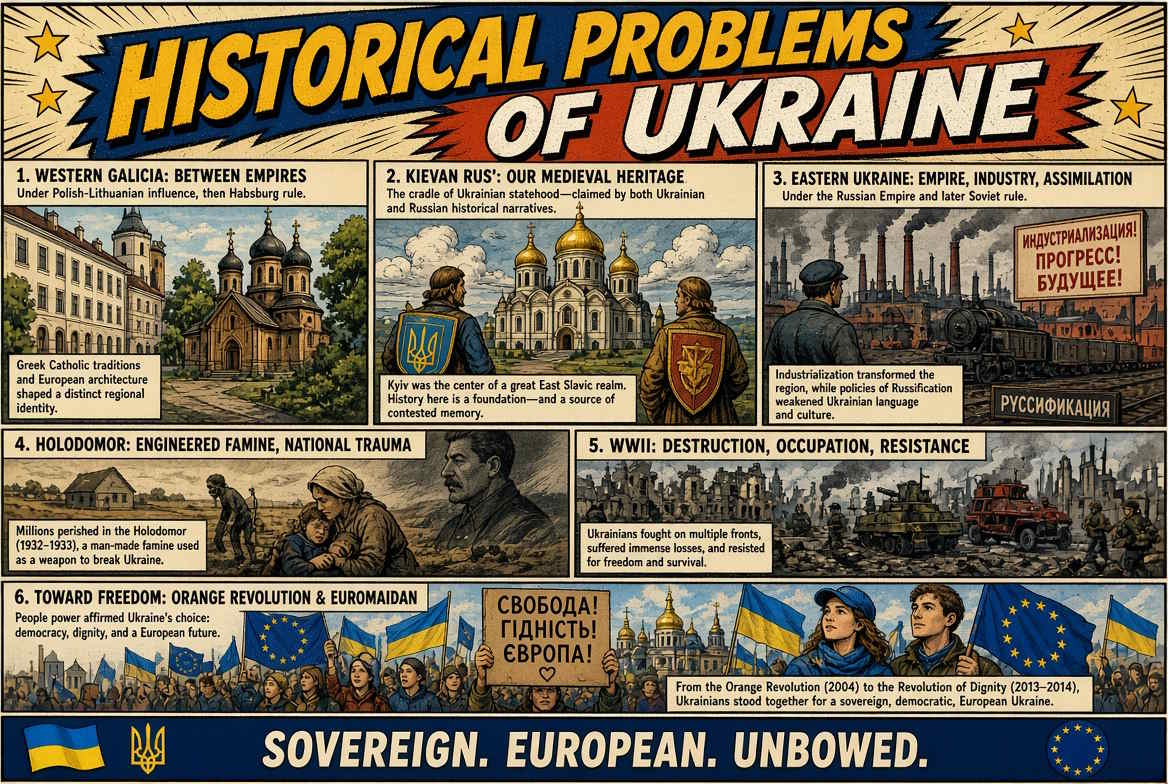
1. The Legacy of Fragmentation (Historical Division)
For centuries, Ukraine did not exist as a unified nation-state; instead, it was divided among various shifting great powers:
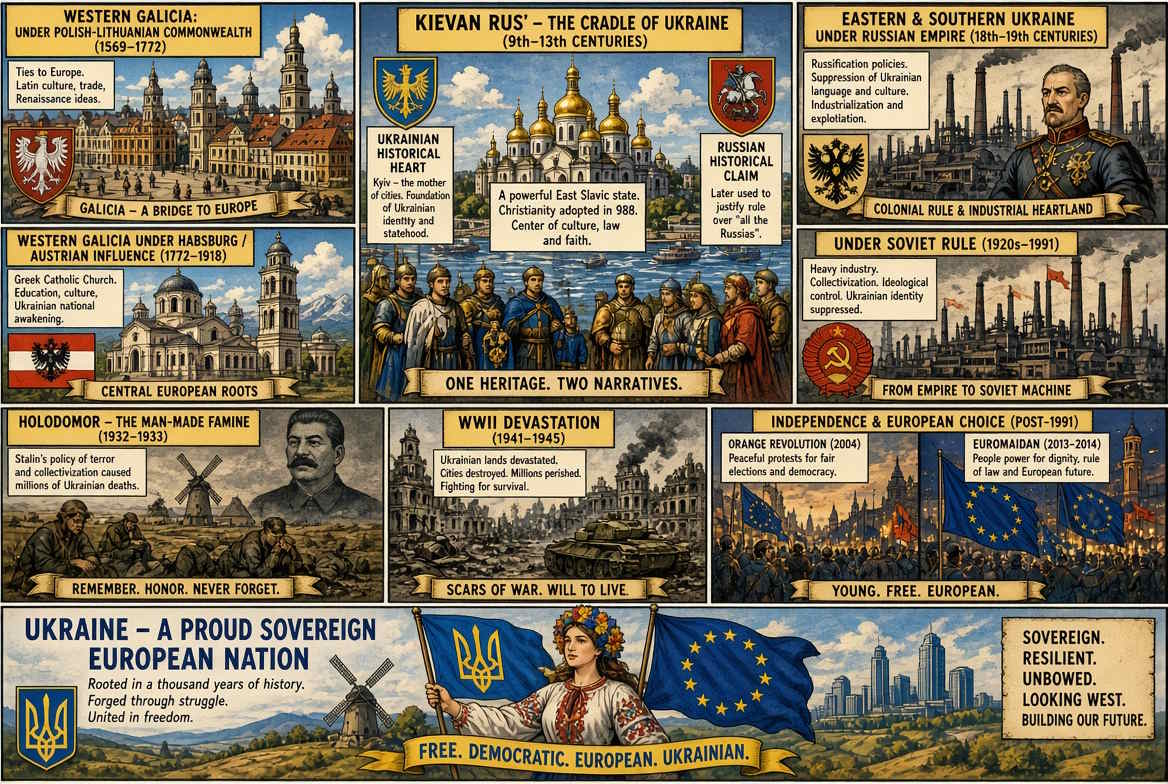
• The West (Galicia): For a long time, this region was part of the Polish-Lithuanian Commonwealth and later the Habsburg Monarchy (Austria-Hungary). Culturally, religiously (Greek Catholic), and politically, this part is strongly oriented toward Central Europe.
• The East and South: From the 17th and 18th centuries onward, these areas came under the rule of the Russian Empire. This region underwent significant Russification; linguistically, it is often more closely linked to Russian, and its economy was shaped by Soviet heavy industry.
2. The Dispute Over Historical Heritage (Kievan Rus’)
Both Ukraine and Russia claim Kievan Rus’—a major medieval realm that existed from the 9th to the 13th century—as their historical cradle:
• The Russian perspective: Views Ukraine (historically often referred to, in a derogatory sense, as “Little Russia”) as an integral part of an “all-Russian nation,” and Kyiv as the “mother of Russian cities.”
• The Ukrainian perspective: Views Ukraine as a distinct nation with a culture and language that developed independently, and which was subjected to imperial appropriation by Moscow.
3. The Traumas of the 20th Century
In the 20th century, Ukraine endured extreme catastrophes that continue to profoundly shape its collective memory and its relationship with Russia to this day:
• The Holodomor (1932–1933): A man-made famine, deliberately orchestrated by Joseph Stalin, which claimed the lives of millions of Ukrainians. In Ukraine, this is regarded as a genocide—a targeted attempt to destroy Ukrainian identity. • World War II and occupation: Ukraine was left completely devastated. Parts of the population collaborated at times with the National Socialists in the hope of achieving an independent state—a fact that continues to be exploited by Soviet (and, today, Russian) propaganda to smear Ukrainian nationalism in its entirety as “fascist.”
4. The Post-1991 Dilemma: The Search for a Post-Soviet Identity
With the collapse of the Soviet Union in 1991, Ukraine gained independence but also inherited internal geopolitical fault lines:
• The “seesaw” policy: For over two decades, Ukrainian governments attempted to strike a balance between moving closer to the European Union/NATO and maintaining, at the same time, close relations with Russia.
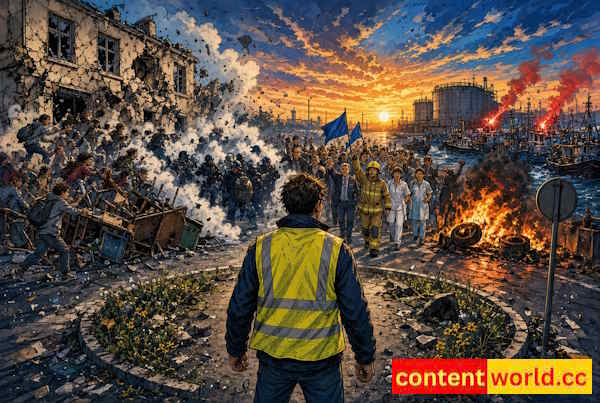
• The revolutions (2004 and 2014): The “Orange Revolution” and the “Euromaidan” protests demonstrated a growing desire among the majority of the population—particularly the younger generation—to definitively orient the country toward the West and break free from Moscow’s sphere of influence.
Summary
Ukraine’s historical challenge lies in its ongoing struggle to have its right to exist as an independent, sovereign nation recognized. While Ukraine seeks to define itself as a European nation-state, the Russian leadership—both historically and politically—denies it this autonomy; a conflict that ultimately culminated in Russia’s war of aggression.
SI gen – contentworld – stories & news & daily freshest content for you!
- Today from Ukraine – shantal.net dec 16, 2019
The most important points:
Ukraine lacks the financial resources to pay the running costs of electricity and gas. When winter gets tough, major supply problems will hit the Ukraine. The IMF and europe are only willing to give money when the debacle on the private bank is cleared up. In addition, corruption and abuse of power must be stopped. these are many challenges – if they do not succeed – then the Ukraine stands before the state bank red.