Topic of the day
South Korea Looks to AI Partnerships With Africa to Expand Its Technology Reach
South Korea is looking to strengthen its technology partnerships with African countries, with artificial intelligence now becoming a major part of the relationship. During the Korea-Africa Economic Cooperation, or KOAFEC, meeting in Seoul in September 2026, officials from South Korea and 45 African countries discussed ways to use AI and digital technology to support development.
AI Moves to the Center of the Partnership
South Korea has proposed a Korean Artificial Intelligence Package, known as the K-AI Package. The initiative combines AI solutions with data centers, electricity infrastructure, digital connectivity, and financing. The idea is to help African countries build the foundations needed to develop and use AI in areas such as agriculture, healthcare, energy, and transportation.
A New Korea-Africa AI Hub
South Korea and the African Development Bank have also signed a letter of intent to establish a Korea-Africa AI Hub. The proposed platform would bring together governments, financial institutions, universities, research centers, and businesses to support AI and digital projects across Africa. It is intended to encourage investment, knowledge sharing, and responsible adoption of AI technologies.
Training and Digital Skills Matter Too
The partnership is not only about computers and data centers. A training institute for advanced technologies, including AI, robotics, and data analysis, is planned in Tanzania as one of the first projects under the K-AI Package. A separate agreement involving the African Development Bank and South Korea’s KAIST will also explore research, AI policy, datasets, technical workshops, and knowledge exchange.
Why Africa Matters to South Korea
Africa offers a large and young consumer market, growing digital needs, and opportunities for investment and technology development. For African countries, partnerships can provide access to expertise, training, infrastructure, and financing. At the same time, South Korean companies and institutions can gain opportunities to participate in emerging digital markets.
A Technology Partnership Still Taking Shape
The latest agreements are an early step rather than a finished transformation. Africa still faces challenges involving electricity, data infrastructure, computing capacity, skills, and financing. The new cooperation therefore focuses on building those foundations alongside AI applications.
South Korea has spent decades building its technology industries. Now, it is looking to share some of that experience while opening new doors for cooperation. In the AI race, the next big partnership may not be about who has the biggest computer, but who can build useful technology where it is needed most.

Entertainment of the day
my car is not your car!
Two young women and a guy with a neon-green phone are standing on a typical residential street in front of some apartment blocks. Two cars are parked there that look completely out of place in the setting: a dark BMW and a bright yellow Chevrolet Corvette (C7, Targa/Convertible). The guy in the black hoodie with orange stripes is filming the whole time, as if he were the evening’s official documentarian. The girls pose, lean against the yellow car, and chat; one of them even opens the door and holds up a yellow piece (presumably the Targa roof). It wraps up with the classic TikTok profile shot.
It started out as a perfectly ordinary date in the concrete housing estate. Anastasia had told her friend: “Come over—I don’t have a car anyway, so we’ll just walk to the kebab shop.”
Ten minutes later, she rolls up—not with one ride, but two: first the sensible BMW (“for everyday use”), then the yellow Corvette, which looks so loud it’s as if someone turned a banana into a sports car.
The guy in the orange sweatpants and the toxic-green phone is already standing at the ready, like a *National Geographic* cameraman who’s just discovered a rare species: “The female is approaching the yellow alpha vehicle. Watch out—she’s touching the roof. Is she going to steal it?” The friend in the beige hoodie heads over to the BMW first, pretending to seriously consider whether it might be the more practical choice after all. The cameraman reaches out his arm—no one knows if he wants to hug her, hand her the phone, or simply check if she’s real.
Then, the switch to the yellow speedster. The two of them stand there as if negotiating who gets to drive the grand prize today. One leans in; the other opens the door and picks up the roof, holding it like a souvenir from a fairground.
In the background: the usual high-rises, a few trees, and a sky that looks like it’s about to cry. And right in the middle, three people acting as if this were the most relaxed Sunday stroll in the world.
The moral of the story: If someone says, “I don’t have a car,” you should still take a look at the driveway. Sometimes, you won’t find an absence of cars—but two of them instead—and one is yellow, with a roof you can carry away.

Cooking of the day
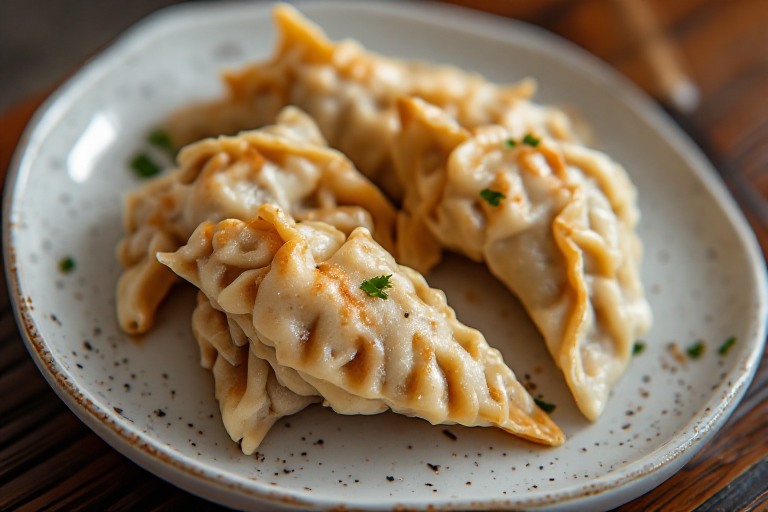
Homemade Gyoza 🥟
Want something crispy, juicy, and packed with flavor? Homemade gyoza is a fun Japanese-inspired dish that looks fancy but is surprisingly easy to make. These little dumplings are filled with seasoned pork and vegetables, then pan-fried until golden and crispy.
Shopping List
250 g ground pork
20 gyoza wrappers
1 cup finely chopped cabbage
2 green onions
2 cloves garlic
1 teaspoon grated fresh ginger
1 tablespoon soy sauce
1 teaspoon sesame oil
1 tablespoon cooking oil
¼ cup water
Soy sauce, for serving
Rice vinegar, for serving
Chili oil, optional
Prepare the Filling
Place the ground pork, chopped cabbage, green onions, garlic, ginger, soy sauce, and sesame oil in a bowl. Mix everything together until well combined. Try not to overmix, or the filling can become too dense.
Fill the Gyoza Wrappers
Place one gyoza wrapper on a clean surface. Put about one tablespoon of filling in the center. Moisten the edge of the wrapper with a little water, then fold it over the filling to create a half-moon shape. Press and pinch the edges firmly to seal the dumpling.
Pan-Fry the Dumplings
Heat the cooking oil in a large non-stick pan over medium heat. Arrange the gyoza in the pan with the flat side facing down. Cook for about 2–3 minutes, or until the bottoms become golden brown.
Steam Until Cooked
Carefully pour the water into the pan and immediately cover it with a lid. Let the gyoza steam for about 5–7 minutes, or until the pork filling is fully cooked and the wrappers become tender.
Make Them Crispy Again
Remove the lid and allow any remaining water to evaporate. Continue cooking for another 1–2 minutes so the bottoms become crispy and golden again.
Serve and Enjoy
Transfer the gyoza to a plate and serve them hot with soy sauce. For an extra kick, mix soy sauce with rice vinegar and a little chili oil. Dip, bite, and enjoy—just be careful because the filling can be very hot!

Vanessa – Lady of the day


Vanessa – camera-shoting will be continued …

Basic knowledge of the day

contentworld.cc