Let’s begin
After his US Open victory, Alexander Zverev has to justify a particular quirk. His final opponent, Ben Shelton, is annoyed and is calling for a rule change.
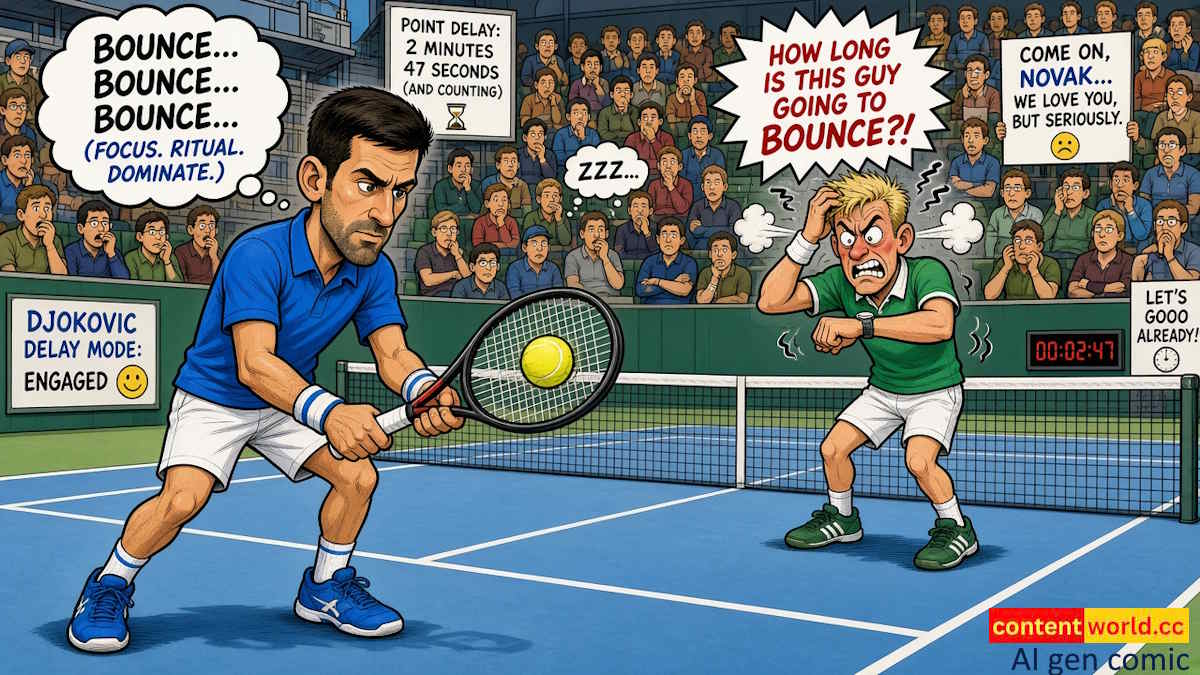
At some point tennis stops being a sport and turns into a patience test with an audience. Novak Djokovic stands on the line, the ball bouncing on his racket — plop, plop, plop — and the opponent across the net waits as if stuck in an app with no loading bar.
He doesn’t start. He doesn’t continue. He doesn’t send the ball over. He does the thing that drives opponents crazy: ritual. Focus. One more bounce. Another. The racket becomes a mini trampoline; the point becomes a theory.
Psychologically, it’s brutally elegant. The returner is ready, split-step, ready again, split-step again — until the legs are thinking and the brain goes on strike. Some people count bounces. Some count seconds. Some count how many times they’ve already thought “any second now.”
It’s simply a loophole in the system. Djokovic does it a lot too—even more so in the past than now. And Nadal always had the absolute longest serving routine of all: twelve identical steps involving tapping his shorts, adjusting his T-shirt twice, and so on. Twelve steps! And after that, he’d usually bounce the ball another ten to fifteen times before finally serving. I find tennis almost as boring as baseball: it feels like 90 percent of the time spent watching isn’t actually playing, but preparing to play. The rallies themselves are usually over in a flash, and the wait for the serve starts all over again. I’ve been saying for years that something needs to change—why not just have a single serve, for instance? If that’s too harsh, then perhaps a slightly milder version: each player gets just one reserve serve per service game to use as a “joker.” But only one joker per service game. Then it would be about playing tennis again, rather than: “Who has the best boring serve?”
To be clear: today’s US Open coverage is mostly raging about the Zverev debate (lots of bounces, little shot-clock pressure on the second serve). Djokovic has known the genre for years, though — he’s even admitted the bouncing can be annoying, including to him. Still, the press and the memes need a name for eternal delay mode. And that name often sounds like: Novak.
Whether a rule change is coming (second-serve clock, bounce limit) is open. Until then, the toughest discipline in tennis isn’t the forehand winner — it’s standing still while the ball dances on the strings and the point… eventually… maybe… begins.